Engelberg is all about alpine riding. Big vertical, technical descents and raw terrain define the experience.
Engelberg sits beneath Mount Titlis — one of Switzerland's most recognised alpine peaks and a landmark that draws visitors year round. The area combines lift accessed trails with natural singletrack that drops straight into the valley. It is a destination known for its intensity, where long descents and demanding terrain are part of every ride. Getting here is straightforward: Engelberg is directly connected to Zurich by train, with or without a bike, making it an easy destination to reach from anywhere in Switzerland or beyond. It also helps to have a home base in the village that gets riders — Ski Lodge Engelberg, sits right in the heart of town and is set up for exactly this kind of trip.
This guide breaks down what mountain biking in Engelberg is really like, where you ride and what to expect.
Why Engelberg is One of Switzerland’s Most Iconic MTB Destinations
Engelberg has built a strong reputation within the mountain biking scene, especially among riders looking for natural and technical enduro terrain.
The scale of vertical descent is one of the biggest draws. With lifts accessing high alpine terrain, it is possible to ride long descents that drop directly back into the lower valley. The terrain is another key factor. Trails are natural, often steep, and shaped by the mountain rather than heavy construction. Roots, rocks and tight sections are part of most descents.
Then there is the setting. Riding takes place in a classic alpine landscape, surrounded by high peaks and open terrain that feels very different from lower elevation destinations. For many riders, Engelberg stands out because it delivers a more raw and demanding riding experience.
Where You Ride in Engelberg
Engelberg is not built around one single trail network. Instead, riding is spread across different mountain areas, with lift access playing a big role in how you move through the terrain.
Titlis Area
The Titlis side is one of the main riding zones in Engelberg, offering high-altitude terrain with long descents that drop deep into the valley. Trails typically start in open alpine landscapes before moving into more technical forest sections lower down.
At the heart of this area is the Jochpass bike park, which sits at 2,206m and forms the centrepiece of built trail riding on this side of the valley. The flagship trail is the Jochpass Trail — a 3.8km flow trail dropping 435m down to Trübsee, packed with curves, waves and optional jumps. It's rated S2 (moderate) and rideable by confident beginners and experienced riders alike. Alongside it, the area offers more natural enduro trails for riders looking for something rawer and less groomed.
The Jochpass side also serves as the starting point for the 4 Lake Tour, a classic Engelberg route that takes in the Trübsee, Engstlensee, Tannalpsee and Melchsee across 43km and nearly 1,900m of climbing. It's a big day out, but one of the most scenic rides in the region.
Lower down on this side of the valley sits Gerschnialp, a newly built trail centre with easy access from the valley floor. The Gerschnialp Trail is a short, fun 1.4km singletrack through the Gerschniwald forest — bike park style, with playful sections, optional jumps and a couple of technical spots. It's a great option for a quick lap or a warm-up before heading higher.
This area is known for:
- Long, continuous descents from alpine altitude
- A built bike park at Jochpass with flow trail and natural enduro options
- The 4 Lake Tour, one of Engelberg's most iconic big rides
- The Gerschnialp trail centre, accessible and fun for all levels
- A mix of open alpine terrain and forest riding lower down
Brunni
On the opposite side of the valley, Brunni offers a different style of riding — this is the sunny side of Engelberg, and it has a character to match.
The terrain moves through alpine meadows and forest, with trails that feel slightly more playful and varied than the direct lines on the Titlis side. It's a great zone for riders who want natural riding with a bit more breathing room between the technical bits.
The Brunnihütte tour is the classic route on this side. Starting from Engelberg village, it climbs up through Ristis — where the road gives way to gravel — and winds up to the Brunnihütte SAC. The standout reward is the view of the Titlis glacier, which is arguably better from here than anywhere else in the valley. It's a proper effort to get up there, but the descent back down and the Herzlisee at the end make it worth it.
Closer to the village, the Bergli trails are a great option for a quicker session. Bergli 1 is a 1km trail with 136m of descent, while Bergli 2 runs to 2km with 259m of descent — both rated S2 and reached by riding up Berglistrasse from the village centre. They're short enough to lap and work well as a warm-up or a standalone session when you don't want to commit to a full mountain day.
What defines this zone:
- Natural trails with a playful, varied feel
- The Brunnihütte tour — a classic climb with exceptional Titlis views
- Bergli 1 & 2 for accessible, close-to-village riding
- A good contrast to the steeper, more direct lines on the Titlis side
Furenalp
The Fürenalp area is Engelberg's third distinct riding zone, and in many ways its most dramatic. Perched high above the valley, it offers a panoramic view of the Spannort massif, the south face of Titlis and the Grassen Glacier — a backdrop that's hard to match anywhere in the region.
Access is via the Fürenalp cable car, which lifts you up onto a stunning balcony traverse deep into Engelberg's long valley — one of those rides where you leave behind the green rolling pastures and head straight into dramatic alpine terrain. Worth planning around: bikes are only allowed on the first and last rides of the day, typically 08:00 and 17:00 during high season.
From the top, the riding is raw and natural — shared trails winding through alpine scenery with the kind of exposure and scale that makes Engelberg stand out from more manicured bike destinations.
What defines this zone:
- Wild, high-alpine riding with exceptional views of Titlis and the Spannort massif
- Cable car access with limited bike transport slots — early starts rewarded
- Natural, hiker-shared trails with a remote, away-from-it-all feel
Surenen Pass
For riders looking for a genuine big-mountain objective, the Surenenpass is one of the defining tours in Central Switzerland. At 36km with up to 1,900m of climbing, it's a serious day out — passing waterfalls and mountain restaurants, through remote terrain, with sections steep enough to require pushing.
The payoff is one of the best descents in the region: the drop from the pass is considered the longest singletrack descent in Central Switzerland, losing over 1,800m of trail all the way to Erstfeld. Riders can ease the climb by using the Fürenalpbahn to gain the first section of altitude.
This is not a casual day out — it's a route that earns its reputation. But for experienced riders with the legs for it, it's the kind of tour you'll be talking about long after you get home.
What defines this route:
- 36km point-to-point with up to 1,900m of climbing
- The longest singletrack descent in Central Switzerland
- Remote, committing terrain — best suited to strong, experienced riders
- Can be combined with the Fürenalp cable car to manage the ascent

What the Trails Are Actually Like
Riding in Engelberg is natural and technical.
Trails are not heavily shaped (except within the small bike parks) . They follow the terrain, which means you will deal with roots, rocks, loose sections and tight turns on most descents.
Steep gradients are common. Many trails drop quickly, and braking control becomes just as important as line choice. Descents are often long and sustained. It is normal to start high and ride all the way back to the valley floor without much interruption.
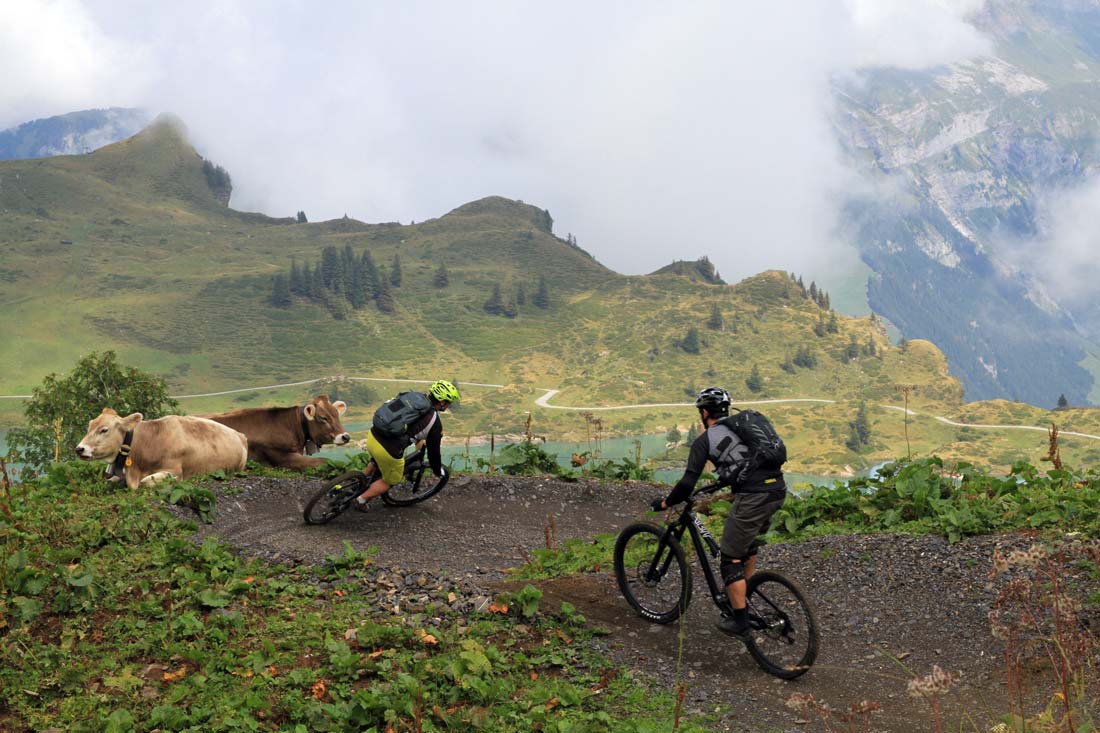
On most trails above the valley, you will share the mountain with grazing herds — dodging them, waiting for them to move, and navigating the patches of ground they leave behind is all part of the experience. It sounds like a novelty, but it becomes a normal part of riding here, and honestly one of the things that makes Engelberg feel like a real mountain destination rather than a purpose-built bike resort.
The riding demands focus. It is less about speed and more about staying controlled, reading the terrain and adapting as conditions change.
Lift Access and Riding Style
Lift access is central to mountain biking in Engelberg.
Gondolas and lifts allow you to reach high starting points quickly, which means most days focus on descending rather than climbing.
At the same time, pedalling still plays a significant role. Engelberg rewards riders who are willing to put in ascent — many of the higher trails and more remote zones can only be reached on the bike, and linking areas together often means serious climbing. The Surenenpass is the clearest example, but even on more typical days, moving between zones involves real elevation gain.
In practice, this creates two main riding styles:
- Lift assisted riding — focused on long descents and maximising vertical
- Exploratory riding — more varied days with pedalling, linking trails and moving between zones, sometimes with significant climbing involved
Our trips combine both approaches depending on conditions and the group.
Mountain Bike vs E-Bike in Engelberg
Both options work well in Engelberg, but they change how you experience the terrain.
On a mountain bike, most riding is built around lift access. You focus on descending and make the most of the vertical available.
On an e-bike, you can move more freely across the valley. You are less dependent on lifts and can link trails in a more flexible way.
This opens up objectives that are much harder to reach on a regular bike — routes like the Surenenpass become far more accessible, and you can combine long descents with pedalling through the lower valley towards Stans and Buochs, taking in areas that a lift-dependent day would never reach.
Best Time of Year to Ride in Engelberg
The main mountain biking season in Engelberg runs from mid-June to October.
This depends on snow conditions, especially at higher elevations.
Summer
July and August offer full access to the lift network and the highest trails.
Conditions are generally dry, and all main areas are open. This is the most reliable period for riding.
Early and Late Season
June and September often bring quieter trails and slightly cooler temperatures.
Higher sections can still be affected by snow early in the season, while late season conditions depend on weather changes.
October can still offer good riding, especially at lower elevations, but access becomes more limited as lifts begin to close.\
Who Is Engelberg Best For
Engelberg is best suited to intermediate and advanced riders.
The terrain is natural and often steep, with technical sections appearing on most trails.
Intermediate riders
You should be comfortable riding roots, rocks and uneven terrain. Some sections may require walking, which is normal here.
Advanced riders
You can take on the full range of trails, including steep descents and more exposed terrain.
Beginner riders
Engelberg is not a typical beginner destination. There are limited easier options, and most trails in the alpine require solid bike handling skills.
Where you stay matters too. On our Engelberg trips we base ourselves at Ski Lodge Engelberg in the centre of the village — comfortable, rider-friendly and a short roll from the lifts, with local knowledge on tap for planning the next day's riding.
Why Ride in Engelberg
Engelberg is not about flow trails or perfectly shaped lines. It is about natural enduro terrain, long descents and riding in a true alpine environment.
The combination of vertical, natural trails and technical riding creates a different kind of experience. It is more demanding, but also more rewarding.
You are not just riding trails. You are riding the mountain.
Frequently Asked Questions
Is Engelberg good for mountain biking?
Yes. Engelberg is known for natural alpine trails, long descents and technical terrain.
When is the best time to ride in Engelberg?
The main season runs from June to October, with July and August offering the most reliable conditions.
Can you ride an e-bike in Engelberg?
Yes — and for many riders, an e-bike is actually the preferred choice in Engelberg. The extra assistance opens up significantly more flexibility, allowing you to explore the full valley, link trails across different zones and reach areas well beyond what lift access alone makes possible.
Is Engelberg suitable for beginners?
Engelberg is better suited to intermediate and advanced riders due to the technical and natural enduro terrain.


.avif)
.avif)
.avif)